In today’s fast-moving industrial environment, businesses need efficient ways to handle materials. Whether it’s a warehouse, factory, or logistics hub, smooth movement of goods plays a key role in productivity. This is where conveyor systems become essential, and one of the most practical options among them is the roller conveyor system.
ArSai Conveyor Systems Pvt. Ltd. help industries simplify their material handling processes with reliable and well-designed conveyor solutions. In this guide, you will clearly understand what a roller conveyor system is, how it works, and the different types of roller conveyors and conveyor rollers used in modern industries.
What is a Roller Conveyor System?
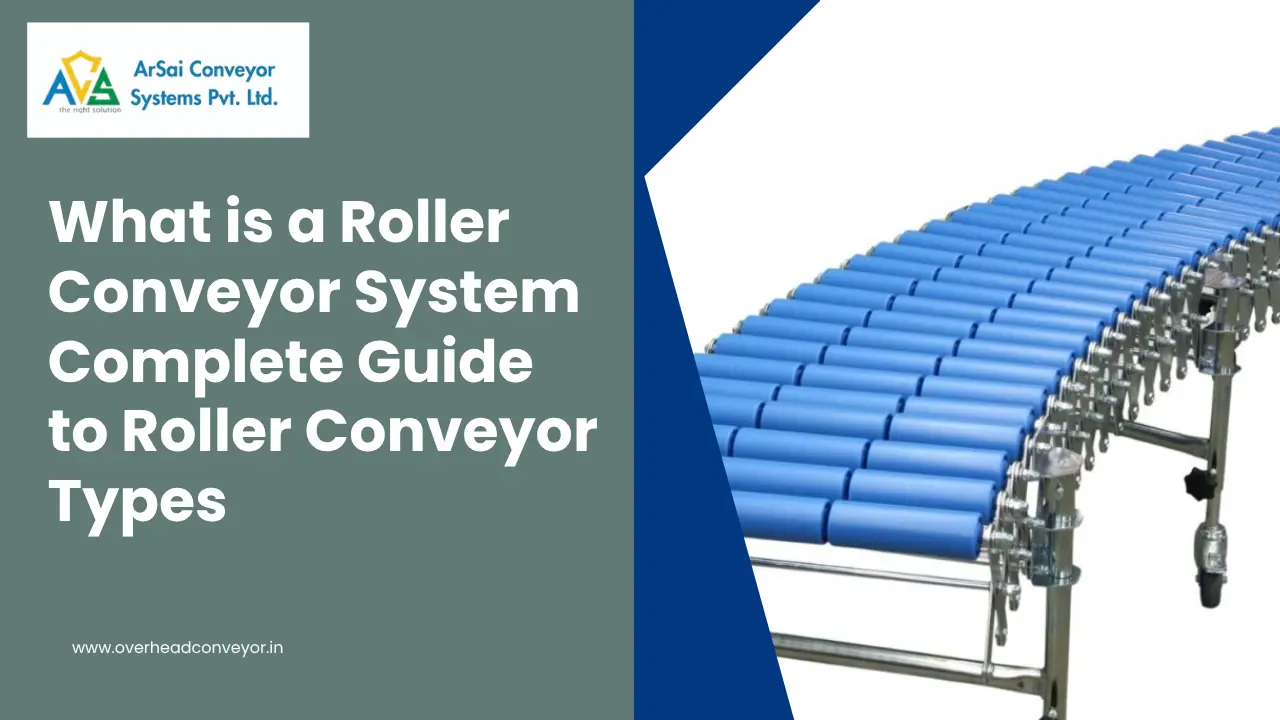
A roller conveyor system is a material handling setup where goods are moved using a series of rollers fixed within a frame. Instead of carrying items manually, products are placed on these rollers and transported smoothly from one point to another.
The movement can happen in two ways. In some cases, items move naturally with gravity when the conveyor is slightly inclined. In other cases, motors are used to rotate the rollers and move goods automatically. Because of this flexibility, roller conveyors are widely used for handling cartons, boxes, pallets, and even heavy industrial loads.
How Does a Roller Conveyor Work?
The working principle of a roller conveyor is simple and practical. Rollers are aligned in a straight line or in curves depending on the layout. When an item is placed on the conveyor, it moves across the rollers either by manual push, gravity, or powered motion.
In a gravity-based system, there is no need for electricity, which makes it cost-effective. On the other hand, powered roller conveyors are used where speed, automation, and continuous flow are required. This combination of simplicity and efficiency is what makes roller conveyors so popular.
Understanding Different Types of Roller Conveyor
There are different roller conveyor types available, and each one is designed for a specific purpose. Choosing the right type depends on the application, load, and working environment.
A gravity roller conveyor is the simplest form and is mostly used where manual handling is acceptable. It works best for lightweight to medium-weight materials and is commonly seen in warehouses.
Powered roller conveyors, on the other hand, are ideal for industries where automation is required. These systems use motors to move goods smoothly without manual effort, making them suitable for high-volume operations.
In heavy-duty environments, chain-driven roller conveyors are often used. They are strong and capable of handling bulky and heavy materials without any issues.
Belt-driven roller conveyors provide smoother and quieter operation. They are commonly used where controlled movement is important, especially in packaging and assembly lines.
Flexible roller conveyors are another useful option. These systems can be expanded, bent, or adjusted easily, making them perfect for temporary setups or spaces where layout keeps changing.
Types of Conveyor Rollers Explained
While roller conveyor types refer to the system itself, conveyor roller types focus on the individual rollers used inside the system. These rollers play a major role in performance and durability.
Steel rollers are commonly used in heavy industries because of their strength and long life. They can handle high loads and tough working conditions.
Plastic rollers are lighter in weight and resistant to corrosion, making them suitable for environments where moisture or chemicals are present.
Rubber-coated rollers are designed to provide better grip. They help reduce slipping and ensure smoother movement of materials.
Grooved rollers are specially made to work with belts. They help maintain alignment and improve efficiency in belt-driven systems.
Tapered rollers are used in curved conveyor systems. Their design allows smooth turning of materials without disruption.
Understanding these types of conveyor rollers helps in selecting the right combination for better performance and longer system life.
Belt Conveyor Roller Types Explained
In addition to roller conveyors, belt conveyors also use different types of rollers to support and guide the belt. These are known as belt conveyor roller types or conveyor belt roller types.
Carrying rollers are placed on the upper side of the conveyor and support the loaded belt. They ensure that the material moves smoothly without sagging.
Return rollers are positioned on the lower side and support the empty belt as it returns to the starting point.
Impact rollers are installed at loading areas where materials are dropped onto the belt. They absorb shock and protect the system from damage.
Idler rollers help in maintaining proper belt alignment and ensure smooth operation throughout the system.
Guide rollers are used to prevent the belt from shifting sideways, which improves safety and efficiency.
All these conveyor roller types work together to maintain the balance and performance of the belt conveyor system.
Benefits of Using Roller Conveyor Systems
A roller conveyor system offers several advantages that make it a preferred choice in many industries. It helps reduce manual labor and increases overall efficiency by speeding up material movement. Since the system is simple in design, maintenance is also low compared to other complex machinery.
Another major benefit is flexibility. Roller conveyors can be customized based on space, load capacity, and operational needs. They also improve workplace safety by minimizing the need for manual lifting and handling.
Because of their durability and cost-effectiveness, roller conveyors are widely used in both small and large-scale industries.
Where Are Roller Conveyor Systems Used?
Roller conveyors are used in a wide range of industries due to their versatility. You can commonly find them in warehouses where goods are sorted and transported efficiently. Manufacturing units use them to move materials between different stages of production.
They are also widely used in packaging industries, airports for luggage handling, and e-commerce companies where fast and accurate delivery systems are required. Their ability to handle different types of loads makes them suitable for almost every industrial setup.
Choosing the Right Roller Conveyor System
Selecting the right roller conveyor system is important for smooth operations. It depends on factors such as the type of material being handled, the weight of the load, and the required speed of movement.
The working environment also plays a role. For example, outdoor setups may require more durable materials, while indoor systems can focus on efficiency and design. Budget and long-term maintenance should also be considered before making a decision.
ArSai Conveyor Systems Pvt. Ltd. guide our clients in choosing the most suitable conveyor system based on their exact requirements.
Why Choose ArSai Conveyor Systems Pvt. Ltd.?
At ArSai Conveyor Systems Pvt. Ltd., we focus on delivering high-quality and reliable conveyor solutions. Our systems are designed with precision and built using durable materials to ensure long-lasting performance. We understand that every business has different needs, which is why we offer customized solutions that match your operations perfectly. From design to installation and support, our team ensures a smooth and hassle-free experience.
Conclusion
A roller conveyor system is one of the most efficient and practical solutions for material handling in modern industries. By understanding what a roller conveyor system is and learning about different roller conveyor types, conveyor roller types, and belt conveyor roller types, businesses can make better decisions and improve their workflow.
If you are planning to upgrade your material handling system, choosing the right conveyor is a smart investment. With the right design and components, it can save time, reduce costs, and increase productivity.
For reliable and efficient solutions, ArSai Conveyor Systems Pvt. Ltd. is always ready to support your business with the best conveyor systems.