In modern manufacturing and material handling industries, automation plays a major role in improving productivity, reducing manual labor, and ensuring smooth workflow. One of the most efficient solutions used in industries like automotive, heavy engineering, appliance manufacturing, and paint shops is the power and free conveyor. These advanced conveyor systems are specially designed to move products efficiently while allowing flexibility in movement, accumulation, and routing.
At Arsai Conveyor Systems Pvt. Ltd., we provide advanced conveyor solutions that help industries streamline production processes with high efficiency and reliability. Understanding how a power and free conveyor system works can help businesses choose the right automation solution for their operations.
What is a Power and Free Conveyor?
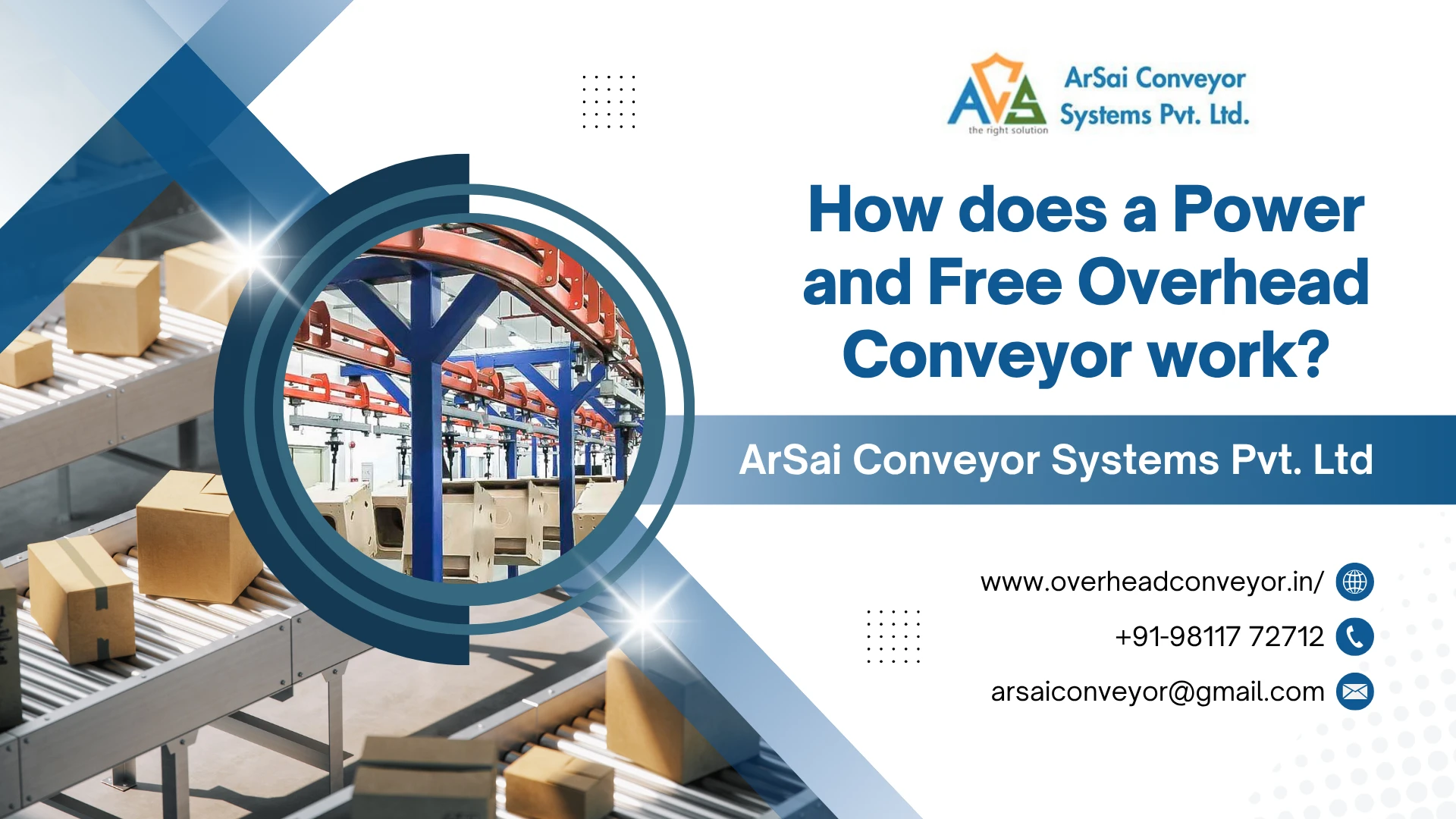
A power and free conveyor is an overhead conveyor system that uses two separate tracks: one for the continuously moving chain (power track) and another for free-moving trolleys (free track). Unlike conventional conveyors that move continuously at the same speed, this system allows carriers to stop, accumulate, transfer, or change routes independently without stopping the main chain.
This flexibility makes power and free conveyors ideal for industries where products require different processing times at different workstations.
Main Components of a Power and Free Conveyor System
To understand how a power and free conveyor system works, it is important to know its key components:
1. Power Chain- The power chain runs continuously inside the powered track. It acts as the driving force of the system and pulls the trolleys through mechanical engagement.
2. Free Trolleys- Free trolleys carry the products or materials being transported. These trolleys move on a separate track and can disengage from the power chain whenever needed.
3. Track System- The conveyor includes separate tracks for the power chain and the free trolleys. This dual-track design provides flexibility and smooth movement.
4. Load Carriers- Load carriers or fixtures are attached to the trolleys to hold components, products, or assemblies securely during transportation.
5. Switches and Stops- Switches, stops, and transfer devices control the movement of trolleys. These components help in accumulation, routing, and workstation positioning.
Working Principle of a Power and Free Conveyor
The working principle of a power and free conveyor is based on controlled engagement and disengagement between the moving power chain and the free trolleys.
Here’s a step-by-step explanation:
Continuous Chain Movement
The power chain continuously moves throughout the conveyor loop. It acts as the primary driving mechanism of the system.
Trolley Engagement
The free trolley engages with the moving chain through a mechanical dog or pusher mechanism. Once engaged, the trolley begins moving along the track carrying the load.
Independent Trolley Control
One of the biggest advantages of power and free conveyor systems is that each trolley can operate independently. If a workstation is occupied or a process requires extra time, the trolley can stop without affecting the movement of other trolleys.
Accumulation Function
When a trolley reaches a stopped trolley ahead, it disengages automatically from the power chain and waits in position. This accumulation feature prevents collisions and allows smooth workflow management.
Re-engagement and Movement
Once the path becomes clear, the trolley automatically re-engages with the moving chain and continues to the next station.
Routing and Transfer
Advanced power and free conveyors can include multiple loops, switches, and transfer sections. This allows products to move to different production lines or processing areas based on operational requirements.
Advantages of Power and Free Conveyor Systems
Industries prefer power and free conveyor systems because of their flexibility and efficiency. Some major benefits include:
- Improved Production Flexibility- Different products can move at different speeds or stop at different stations without interrupting the overall system.
- Better Space Utilization- As an overhead system, the conveyor saves valuable floor space and keeps the workspace organized.
- Reduced Manual Handling- Automation reduces labor dependency and minimizes the risk of workplace injuries.
- Increased Productivity- Continuous and controlled movement improves workflow efficiency and production output.
- Easy Accumulation- Products can queue automatically without damaging components or stopping the entire line.
- Customizable Design- A power and free conveyor system can be customized according to plant layout, product type, and production capacity.
Applications of Power and Free Conveyors
Because of their flexibility, power and free conveyors are used in many industries, including:
- Automotive assembly plants
- Paint shop operations
- Heavy equipment manufacturing
- Appliance production units
- Powder coating industries
- Warehousing and material handling facilities
- Industrial assembly lines
These systems are especially useful where products need varying processing times or multiple routing options.
Why Industries Choose Power and Free Conveyor Systems
Modern industries demand smart automation solutions that improve operational efficiency while maintaining production flexibility. A power and free conveyor system meets these requirements by allowing independent movement, accumulation, and routing of products.
Compared to traditional conveyors, these systems provide better control over production flow and reduce downtime. This is why industries with complex assembly processes increasingly rely on power and free conveyor systems for efficient material handling.
Choosing the Right Conveyor Manufacturer
Selecting the right manufacturer is essential for achieving long-term performance and reliability. A well-designed power and free conveyor should offer durability, smooth operation, energy efficiency, and easy maintenance.
Arsai Conveyor Systems Pvt. Ltd. specializes in manufacturing advanced conveyor solutions designed to meet the unique needs of various industries. With quality engineering and customized designs, the company helps businesses improve productivity and streamline material handling processes.
Conclusion
A power and free conveyor is one of the most advanced and flexible material handling systems available for industrial automation. By allowing independent trolley movement, accumulation, and controlled routing, these systems improve efficiency and optimize production flow.
Whether used in automotive plants, assembly lines, or heavy manufacturing industries, power and free conveyors provide reliable and cost-effective automation solutions. Investing in the right power and free conveyor system can significantly improve operational performance, reduce manual handling, and support long-term industrial growth.