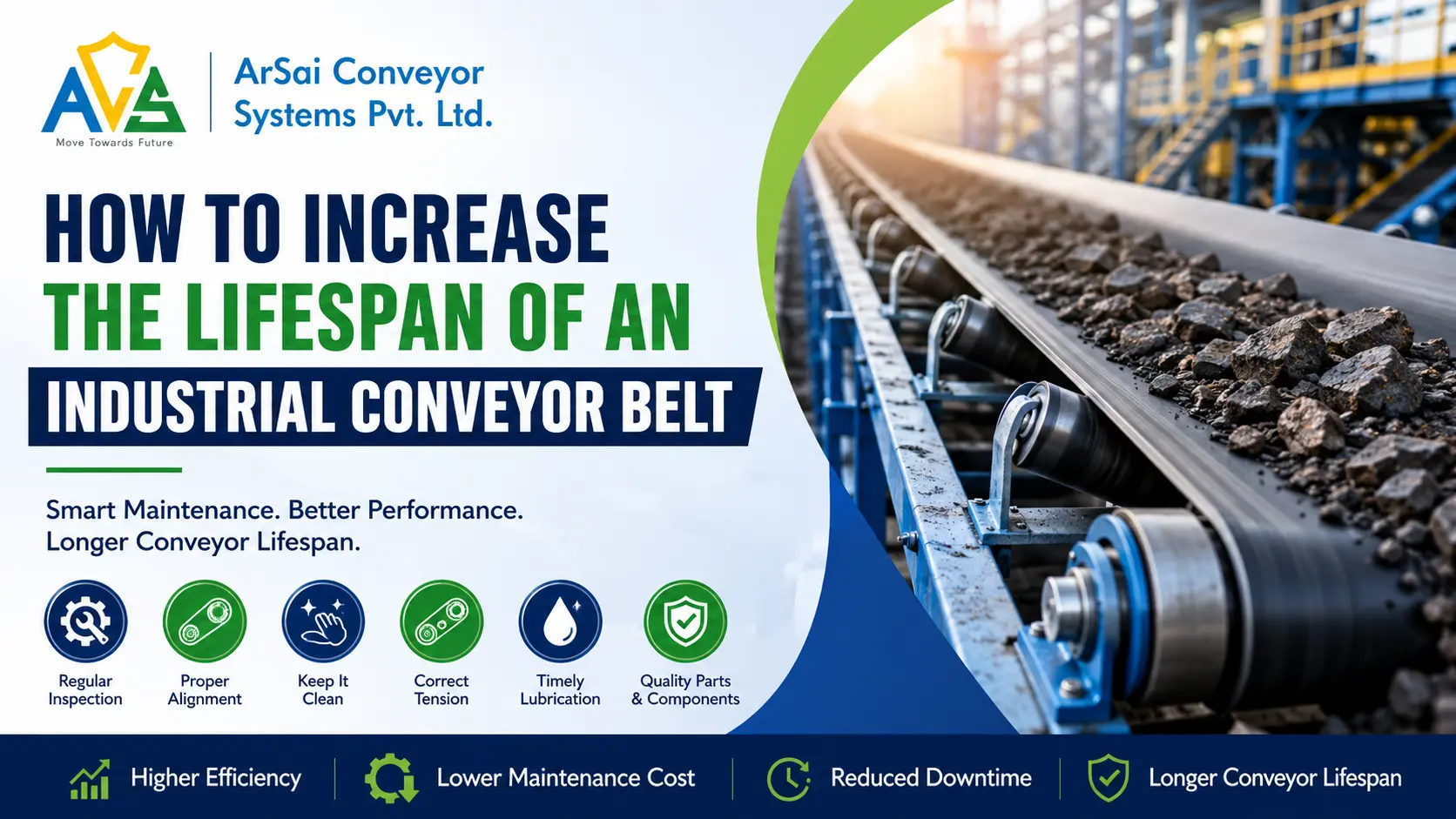
Industrial conveyor systems are the backbone of modern manufacturing, warehousing, logistics, mining, food processing, automotive, pharmaceuticals, and packaging industries. They ensure smooth material movement, reduce manual labor, and improve operational efficiency. However, the performance of any conveyor system largely depends on one critical component—the conveyor belt.
Understanding how to increase the lifespan of an industrial conveyor belt is essential for reducing maintenance costs, minimizing downtime, and improving productivity. A well-maintained conveyor belt can operate efficiently for many years, while poor maintenance and improper usage can lead to frequent breakdowns, costly repairs, and unexpected production losses.
At ArSai Conveyor Systems Pvt. Ltd., we believe that proper installation, regular inspections, preventive maintenance, and selecting the right conveyor system are the keys to maximizing conveyor lifespan. In this guide, we’ll discuss practical strategies that help industries extend the life of their conveyor belts while ensuring consistent performance.
Why Conveyor Belt Lifespan Matters
Every industrial facility depends on uninterrupted material handling. When a conveyor belt fails unexpectedly, production often comes to a standstill. This not only increases repair expenses but also affects delivery schedules and overall business efficiency.
A longer conveyor lifespan offers several advantages, including:
- Lower maintenance costs
- Reduced equipment downtime
- Improved workplace safety
- Better material handling efficiency
- Higher return on investment
- Increased operational productivity
Investing time in preventive maintenance is significantly more cost-effective than replacing conveyor belts frequently.
Read More: Types of Conveyor Systems
Choose the Right Conveyor Belt for Your Application
One of the most common reasons for premature belt failure is selecting the wrong conveyor belt.
Different industries require different belt materials depending on:
- Load capacity
- Product weight
- Temperature conditions
- Chemical exposure
- Moisture levels
- Abrasion resistance
For example, food processing industries require food-grade belts, while mining and heavy manufacturing need abrasion-resistant conveyor belts capable of handling heavy loads.
Working with experienced manufacturers like ArSai Conveyor Systems Pvt. Ltd. ensures that your conveyor belt matches your application perfectly.
Ensure Proper Conveyor Belt Installation
Even the highest-quality conveyor belt will fail early if it is installed incorrectly.
Professional installation helps ensure:
- Correct belt alignment
- Proper pulley positioning
- Accurate belt tension
- Smooth roller operation
- Balanced load distribution
Improper installation causes uneven wear, belt drifting, excessive friction, and roller damage, all of which significantly reduce conveyor lifespan.
Maintain Correct Belt Tension
Over-tightening and under-tightening are equally harmful.
If the belt is too tight:
- Bearings wear faster.
- Rollers experience higher stress.
- The motor consumes more power.
- Belt stretching increases.
If the belt is too loose:
- Belt slippage occurs.
- Product movement becomes unstable.
- Material spills become common.
- Pulley wear increases.
Maintaining the manufacturer’s recommended tension improves efficiency while extending conveyor lifespan.
Perform Regular Cleaning
Dust, oil, grease, chemicals, and debris gradually accumulate on conveyor belts.
Without regular cleaning, these contaminants can:
- Damage belt surfaces
- Increase friction
- Affect tracking
- Reduce grip
- Cause material contamination
Cleaning schedules should be established according to the operating environment.
Industries such as pharmaceuticals, food processing, and packaging require more frequent cleaning compared to general manufacturing facilities.
Inspect Rollers Frequently
Rollers support the entire conveyor belt system.
Damaged rollers create uneven movement, increasing belt wear and energy consumption.
Routine roller inspections should include checking for:
- Free rotation
- Surface wear
- Bearing condition
- Rust
- Noise
- Misalignment
Replacing damaged rollers early prevents larger conveyor failures.
Check Conveyor Belt Alignment
Poor belt tracking is one of the leading causes of premature conveyor damage.
A misaligned conveyor belt can:
- Rub against the frame
- Damage belt edges
- Cause uneven wear
- Increase motor load
- Create safety hazards
Operators should inspect alignment regularly and adjust tracking whenever necessary. Automatic belt tracking systems can also improve long-term performance.
Lubricate Moving Components
While conveyor belts themselves usually don’t require lubrication, surrounding mechanical components certainly do.
These include:
- Bearings
- Chains
- Drive units
- Motors
- Gearboxes
- Rollers
Proper lubrication reduces friction and prevents unnecessary wear throughout the conveyor system. Always use lubricants recommended by the equipment manufacturer.
Avoid Conveyor Overloading
Every conveyor belt is designed with a maximum load capacity.
Consistently exceeding this capacity can result in:
- Belt stretching
- Roller failure
- Motor overload
- Increased vibration
- Structural damage
Training employees to follow load guidelines helps maximize conveyor lifespan while maintaining workplace safety.
Monitor Belt Wear Regularly
Waiting until visible damage appears often leads to costly repairs.
Instead, establish preventive inspections to monitor:
- Belt thickness
- Surface cracks
- Edge damage
- Joint condition
- Cover wear
- Splice integrity
Early detection allows small issues to be repaired before they become major failures.
Replace Worn Components Promptly
Sometimes the conveyor belt itself isn’t the problem.
Other worn components such as:
- Rollers
- Bearings
- Pulleys
- Drive belts
- Scrapers
- Skirting systems
can damage a perfectly good conveyor belt if ignored.
Replacing inexpensive components early often prevents costly conveyor belt replacement.
Use High-Quality Spare Parts
Low-cost replacement parts may appear economical initially but often reduce system reliability.
Premium-quality spare parts offer:
- Better durability
- Improved compatibility
- Lower maintenance
- Longer service intervals
- Higher operational efficiency
Quality components contribute significantly to increasing conveyor lifespan.
Train Conveyor Operators
Human error remains one of the leading causes of conveyor belt damage.
Operators should understand:
- Safe loading practices
- Emergency shutdown procedures
- Cleaning methods
- Daily inspections
- Belt tracking basics
- Preventive maintenance schedules
A trained workforce can identify potential problems before they cause equipment failure.
Maintain Proper Working Environment
Environmental conditions directly affect conveyor performance.
Factors such as:
- Excessive heat
- Humidity
- Dust
- Chemicals
- Moisture
- Outdoor exposure
can reduce belt durability if not managed properly.
Selecting the correct belt material for the environment helps improve long-term performance.
Schedule Preventive Maintenance
Preventive maintenance is far more economical than emergency repairs.
An effective maintenance schedule includes:
- Daily visual inspections
- Weekly cleaning
- Monthly alignment checks
- Roller inspection
- Motor servicing
- Belt tension adjustments
- Annual system audits
Routine maintenance keeps the entire conveyor system operating efficiently.
Upgrade Older Conveyor Systems
Older conveyor systems often consume more energy and require frequent maintenance.
Modern conveyor systems include features such as:
- Improved belt materials
- Better drive mechanisms
- Energy-efficient motors
- Automatic belt tracking
- Smart monitoring systems
Upgrading outdated equipment can significantly improve both productivity and conveyor lifespan.
Why Choose ArSai Conveyor Systems Pvt. Ltd.?
At ArSai Conveyor Systems Pvt. Ltd., we manufacture high-performance conveyor systems designed for long-lasting reliability and superior material handling efficiency. Our extensive range includes roller conveyors, belt conveyors, chain conveyors, slat conveyors, gravity conveyors, overhead conveyors, telescopic conveyors, and customized automation solutions for diverse industrial applications.
Our experienced engineering team helps customers select the right conveyor system based on load capacity, operating conditions, and production requirements. From design and manufacturing to installation and after-sales support, we focus on delivering solutions that maximize productivity while reducing maintenance costs.
Whether you need a new conveyor system or want to improve the performance of your existing equipment, ArSai Conveyor Systems Pvt. Ltd. offers dependable solutions backed by quality manufacturing and technical expertise.
Conclusion
Knowing how to increase the lifespan of an industrial conveyor belt is essential for every business that relies on material handling systems. Proper belt selection, professional installation, regular inspections, preventive maintenance, correct belt tension, and employee training all play a crucial role in extending conveyor lifespan.
A well-maintained conveyor belt not only reduces repair expenses but also improves productivity, minimizes downtime, and increases operational efficiency. By investing in quality equipment and following a proactive maintenance strategy, businesses can maximize the value of their conveyor systems for years to come.
If you’re looking for reliable, durable, and customized conveyor solutions, ArSai Conveyor Systems Pvt. Ltd. is your trusted partner for advanced material handling systems designed to deliver exceptional performance and long service life.