
Garment Handling Conveyor Manufacturers
Efficient garment movement is an important part of modern apparel manufacturing, garment warehouses, laundries, dry-cleaning units, and distribution facilities. When garments are moved manually from one workstation to another, it can consume valuable time, require additional manpower, and increase the chances of garments getting misplaced or damaged. A well-designed conveyor system makes this movement faster, more organized, and easier to manage.
As Garment Handling Conveyor Manufacturers, we provide conveyor solutions designed to transport garments smoothly between different operational areas. These systems can be configured according to the available space, garment type, handling requirements, and workflow of the facility. From production and finishing areas to sorting, storage, inspection, and dispatch, garment conveyors help maintain a continuous flow of material.
A garment conveyor can also make better use of overhead space, keeping the floor area relatively clear for workers, machinery, and other operations. This is particularly useful where floor space is limited but garment movement and storage requirements are high.
Garment Handling System Manufacturers
Garment handling is not simply about moving clothes from one point to another. The system should maintain an organized flow while reducing unnecessary manual movement. Our garment handling solutions are designed to support smooth transportation of hanging garments and improve coordination between different stages of an operation.
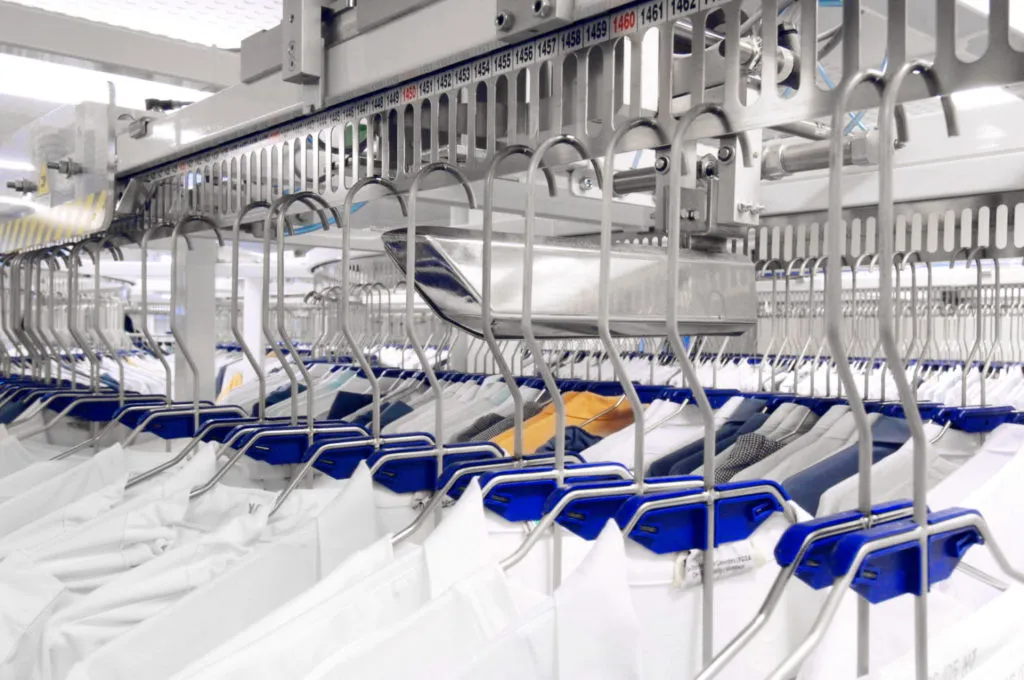
Uses of Garment Conveyor Systems
Depending on the application, a garment handling system can be used for:
- Moving garments between production workstations
- Handling finished garments before packing
- Sorting garments according to orders or destinations
- Moving garments between storage and dispatch areas
- Organizing garments in laundries and dry-cleaning facilities
- Supporting uniform and workwear handling
- Connecting different sections of a garment processing facility
The system can be planned around the existing layout so that garments follow a practical route without creating unnecessary obstruction. Properly designed handling equipment can also reduce repeated lifting, carrying, and walking by operators, making day-to-day operations more convenient.
Why Is a Garment Conveyor Important?
In a garment-related facility, hundreds or thousands of clothing items may need to be moved during a working shift. Depending entirely on manual handling can make the process slower, especially when garments need to travel between multiple departments.
A garment conveyor provides a controlled route for garment movement and offers several practical benefits.
- Faster Material Movement: Garments can be transported continuously between designated points instead of being carried manually from one location to another.
- Better Space Utilization: Overhead conveyor arrangements can utilize vertical space and help keep valuable floor space available for production and other activities.
- Reduced Manual Handling: Employees spend less time carrying garments, allowing them to concentrate on production, inspection, packing, sorting, and other important tasks.
- Improved Garment Organization: Garments can remain arranged on hangers or in designated positions during transportation, making sorting and retrieval easier.
- Lower Risk of Handling Damage: Controlled movement can reduce unnecessary folding, dragging, or repeated handling that may affect finished garments.
- Smoother Workflow: Connecting different operational stages through a conveyor helps create a more consistent flow and can reduce delays between departments.
For facilities dealing with high garment volumes, these advantages can make a significant difference in everyday productivity and organization.
Garment Conveyor Systems Suppliers
Choosing the right garment conveyor depends on more than the required conveyor length. The garment type, load, movement pattern, available height, number of workstations, storage requirements, and expected operating volume should all be considered before finalizing the system.
Garment conveyor systems can be developed for different layouts and applications, including straight runs, turns, loops, multi-level arrangements, and customized routing. The right configuration allows the conveyor to fit naturally into the facility instead of forcing the existing workflow to change unnecessarily.
A properly planned system can support garment transportation across manufacturing, finishing, inspection, sorting, storage, laundry, dry cleaning, uniform handling, and dispatch operations. Where required, automated identification and sorting technologies can also be integrated to improve garment tracking and routing.
The objective is simple: move garments efficiently, use available space intelligently, and make daily handling easier for the workforce.
Applications of Garment Handling Conveyors
Garment conveyor systems are suitable for a wide range of applications, such as:
- Garment manufacturing units
- Apparel production facilities
- Industrial laundries
- Dry-cleaning units
- Garment warehouses
- Uniform storage and distribution
- Fashion and retail distribution centers
- Garment sorting and inspection areas
- Packing and dispatch sections
Whether the requirement is for regular garment transportation or a more organized storage and retrieval process, a suitable conveyor arrangement can be developed according to the operational needs of the facility.
Specifications - Garment Handling Conveyor
Specification | Details |
|---|---|
Load Capacity | Up to 200 kg (440 lbs) |
Hanger Spacing | 300 mm to 600 mm (12 in to 24 in) |
Conveyor Speed | 0.2 m/s to 1 m/s (0.7 ft/s to 3.3 ft/s) |
Hanger Capacity | Up to 500 hangers |
Track Material | Steel or Aluminum |
Frame Material | Steel, Aluminum, or Stainless Steel |
Operating Temperature | 0°C to 50°C (32°F to 122°F) |
Power Supply | 230V/400V AC, 50/60 Hz |
Noise Level | < 75 dB |
Drive Type | Electric Motor |
Control System | PLC or Manual Control |